
Genesis Annotated: Chapter 11

Chapter Overview

Chapter 11 introduces the Tower of Babel and a time that all languages were supposedly the same. God decides that people working together is a bad thing, because they might accomplish something awesome, and he goes down to make everyone start speaking different languages.

Additional Thoughts

Genesis 10:5, 10:20, and 10:31 all specify that different languages (aka: tongues) exist. In all likelihood, this is a story that was brought in from another source and then given a tie-in with Noah to try make it seem authentic. Unfortunately, chapter 10 states that different languages already exist. Too many “if-s” have to be taken into account to give this a reason to exist in this text.

The Scientific/logic/sequence mistakes in this chapter

  1. Contradicts chapter 10 claiming that multiple languages exist (Genesis 11:1)
  2. Languages have evolved over time and can be traced back to see how related they are to one another. An event such as this would have no such indicators (Genesis 11:7-9)
  3. According to Genesis 6:3, 120 should be the max age (Genesis 11:12,13,15,16,19,21,23,24,32)
  4. Does not line up with other Genesis 10 genealogies (Genesis 11:13,15,17,18)

Chapter 11: The tower of babel
AKA: God introduces barriers to collaboration

  1. And the whole earth was of one language, and of one speech.
  2. And it came to pass, as they journeyed from the east, that they found a plain in the land of Shinar; and they dwelt there.
  3. And they said one to another, Go to, let us make brick, and burn them thoroughly. And they had brick for stone, and slime had they for morter.
  4. And they said, Go to, let us build us a city and a tower, whose top may reach unto heaven; and let us make us a name, lest we be scattered abroad upon the face of the whole earth.
  5. And the Lord came down to see the city and the tower, which the children of men builded.
  6. And the Lord said, Behold, the people is one, and they have all one language; and this they begin to do: and now nothing will be restrained from them, which they have imagined to do.
  7. Go to, let us go down, and there confound their language, that they may not understand one another’s speech.
  8. So the Lord scattered them abroad from thence upon the face of all the earth: and they left off to build the city.
  9. Therefore is the name of it called Babel; because the Lord did there confound the language of all the earth: and from thence did the Lord scatter them abroad upon the face of all the earth.
  10. These are the generations of Shem: Shem was an hundred years old, and begat Arphaxad two years after the flood:
  11. And Shem lived after he begat Arphaxad five hundred years, and begat sons and daughters.
  12. And Arphaxad lived five and thirty years, and begat Salah:
  13. And Arphaxad lived after he begat Salah four hundred and three years, and begat sons and daughters.
  14. And Salah lived thirty years, and begat Eber:
  15. And Salah lived after he begat Eber four hundred and three years, and begat sons and daughters.
  16. And Eber lived four and thirty years, and begat Peleg:
  17. And Eber lived after he begat Peleg four hundred and thirty years, and begat sons and daughters.
  18. And Peleg lived thirty years, and begat Reu:
  19. And Peleg lived after he begat Reu two hundred and nine years, and begat sons and daughters.
  20. And Reu lived two and thirty years, and begat Serug:
  21. And Reu lived after he begat Serug two hundred and seven years, and begat sons and daughters.
  22. And Serug lived thirty years, and begat Nahor:
  23. And Serug lived after he begat Nahor two hundred years, and begat sons and daughters.
  24. And Nahor lived nine and twenty years, and begat Terah:
  25. And Nahor lived after he begat Terah an hundred and nineteen years, and begat sons and daughters.
  26. And Terah lived seventy years, and begat Abram, Nahor, and Haran.
  27. Now these are the generations of Terah: Terah begat Abram, Nahor, and Haran; and Haran begat Lot.
  28. And Haran died before his father Terah in the land of his nativity, in Ur of the Chaldees.
  29. And Abram and Nahor took them wives: the name of Abram’s wife was Sarai; and the name of Nahor’s wife, Milcah, the daughter of Haran, the father of Milcah, and the father of Iscah.
  30. But Sarai was barren; she had no child.
  31. And Terah took Abram his son, and Lot the son of Haran his son’s son, and Sarai his daughter in law, his son Abram’s wife; and they went forth with them from Ur of the Chaldees, to go into the land of Canaan; and they came unto Haran, and dwelt there.
  32. And the days of Terah were two hundred and five years: and Terah died in Haran.

  1. A reading of chapter 10:5, 10:20, and 10:31 suggests otherwise
  2. Who? They? Who is they? Noah? Some of his sons?

  3. Is slime a good mortar? I really don’t know. I would suspect not though. Mortar needs something to harden, and random slime probably won’t cut it.
  4. I hope there aren’t any drastic consequences for actions of great hubris. <sarcasm>We’ve never seen anything like consequences for hubris in any other mythologies before. </sarcasm>
  5. He couldn’t just observe this from on high? Or just know that it’s been made? Again, no omniscience. That was fabricated later.
  6. Oh no, people can communicate effectively and this could enable them to accomplish things.


  7. Seems like a dick move to me.
    the “us” seems to indicate that this was a polytheistic religion at the time.
  8. Why are claims of languages evolving naturally over time met with less resistance than species evolution?
  9. So… god doesn’t want people working together and able to communicate in peace. Why is this a good thing? Thank goodness for google translate nowadays.

  10. Boring genealogy alert. Note the ages though. Genesis 6:3 says they should be 120 years max. 1 kiddo.
  11. How many? Nobody knows. Why? Because genealogies really don’t matter.

  12. Lines up with chapter 10 so far

  13. No. Read chapter 10. He had 1 kid: Salah. It’s almost like these genealogies were made up to support a tale or something.
  14. mmkay.

  15. No. Genesis 10:25 shows 2 sons. No daughters. Either one chapter is right, or both are wrong.
  16. He didn’t get the memo from Genesis 6:3 either.
  17. No. Chapter 10 shows 2 sons only. Maybe chapter 10 was worth reading after all, boring as it was.
  18. This child is new and isn’t in chapter 10
  19. 120 years as a maximum age anyone? Anyone? No?

  20. mmkay

  21. Plot demands that these people are able to live longer than the 120 year maximum. Buy why?
  22. next

  23. Older than 120 years again. Either god can’t enforce an age limit, or these people just said no to it.
  24. Below 120…. but only for this verse

  25. This would put him at 148. Still above 120 as a maximum age.

  26. We’re starting to see a few characters that will show up later now.
  27. Lot and Abram will show up later. Keep an eye on them.

  28. His daughter, brought up next verse, must not be important enough to the writer to record anywhere except as a wife.
  29. So… we have Nahor, who is Haran’s brother, marrying Haran’s daughter. Marrying your siblings children is A-OK according to this text. This can cause some genetic problems as we know today.
  30. 0 kiddos.
  31. Everyone gets to go on a field trip.


  32. Again…. 120 max age memo was missed.

Additional Notes

There is a VERY similar story from Sumeria that describes a “confusion of tongues” involving the construction of temples. Read about it on wikipedia. https://en.wikipedia.org/wiki/Enmerkar_and_the_Lord_of_Aratta

Also, fun fact: There MIGHT be a VERY small kernel of truth to the story of the tower of babel, but not in the way that biblically-minded people might expect. See here: https://en.wikipedia.org/wiki/Tower_of_Babel#Etemenanki,_the_ziggurat_at_Babylon


To briefly explain, Babel, short for Babylon, started construction of a large tower in honor of the god Marduk. When King Nabopolassar started the tower, Babylon’s writing system (Cuneiform) was still in use. Schools taught children how to read and write it, and the ability to transfer information allowed Babylon to better manage itself as a civilization.

After Nebuchadnezzar’s death, the construction was halted and the civilization saw a decline in education, leading to the loss of knowledge of it’s writing system. This loss of knowledge kept anyone from being able to read the Cuneiform tablets, and after several generations, no one knew what Cuneiform was anymore. Thus, people couldn’t communicate as effectively anymore.
Genesis Annotated: Chapter 10

Chapter Overview

Genealogies upon genealogies. This can mostly be skipped. It seems like the author (or one of several authors) really liked the number 7. Funnily enough, the author’s desire to show everything coming out as 7 extends to showing children from additional 3 generations down rather than just 2. It looks like they realized that trying to show a specific number of children was pointless later on.

Additional thoughts

Just skip this chapter. It’s not really worth reading. The only real thing of note is the mention of different tongues existing. This is contradicted in the next chapter.

The Scientific/logic/sequence mistakes in this chapter

  1. The next chapter contradicts this one. Multiple languages exist here. In chapter 11, everyone speaks the same language (Genesis 10:6)

Chapter 10: Boring Genealogies

  1. Now these are the generations of the sons of Noah, Shem, Ham, and Japheth: and unto them were sons born after the flood.
  2. The sons of Japheth; Gomer, and Magog, and Madai, and Javan, and Tubal, and Meshech, and Tiras.
  3. And the sons of Gomer; Ashkenaz, and Riphath, and Togarmah.
  4. And the sons of Javan; Elishah, and Tarshish, Kittim, and Dodanim.
  5. By these were the isles of the Gentiles divided in their lands; every one after his tongue, after their families, in their nations.
  6. And the sons of Ham; Cush, and Mizraim, and Phut, and Canaan.
  7. And the sons of Cush; Seba, and Havilah, and Sabtah, and Raamah, and Sabtechah: and the sons of Raamah; Sheba, and Dedan.
  8. And Cush begat Nimrod: he began to be a mighty one in the earth.
  9. He was a mighty hunter before the Lord: wherefore it is said, Even as Nimrod the mighty hunter before the Lord.
  10. And the beginning of his kingdom was Babel, and Erech, and Accad, and Calneh, in the land of Shinar.
  11. Out of that land went forth Asshur, and builded Nineveh, and the city Rehoboth, and Calah,
  12. And Resen between Nineveh and Calah: the same is a great city.
  13. And Mizraim begat Ludim, and Anamim, and Lehabim, and Naphtuhim,
  14. And Pathrusim, and Casluhim, (out of whom came Philistim,) and Caphtorim.
  15. And Canaan begat Sidon his first born, and Heth,
  16. And the Jebusite, and the Amorite, and the Girgasite,
  17. And the Hivite, and the Arkite, and the Sinite,
  18. And the Arvadite, and the Zemarite, and the Hamathite: and afterward were the families of the Canaanites spread abroad.
  19. And the border of the Canaanites was from Sidon, as thou comest to Gerar, unto Gaza; as thou goest, unto Sodom, and Gomorrah, and Admah, and Zeboim, even unto Lasha.
  20. These are the sons of Ham, after their families, after their tongues, in their countries, and in their nations.
  21. Unto Shem also, the father of all the children of Eber, the brother of Japheth the elder, even to him were children born.
  22. The children of Shem; Elam, and Asshur, and Arphaxad, and Lud, and Aram.
  23. And the children of Aram; Uz, and Hul, and Gether, and Mash.
  24. And Arphaxad begat Salah; and Salah begat Eber.
  25. And unto Eber were born two sons: the name of one was Peleg; for in his days was the earth divided; and his brother’s name was Joktan.
  26. And Joktan begat Almodad, and Sheleph, and Hazarmaveth, and Jerah,
  27. And Hadoram, and Uzal, and Diklah,
  28. And Obal, and Abimael, and Sheba,
  29. And Ophir, and Havilah, and Jobab: all these were the sons of Joktan.
  30. And their dwelling was from Mesha, as thou goest unto Sephar a mount of the east.
  31. These are the sons of Shem, after their families, after their tongues, in their lands, after their nations.
  32. These are the families of the sons of Noah, after their generations, in their nations: and by these were the nations divided in the earth after the flood.

  1. Looks like we get more genealogies. This book really likes it’s genealogies.

  2. 7 kiddos


  3. 3 kiddos

  4. 4 kiddos. Added to the previous verse, 7.

  5. So… different languages exist? I thought the tower of babel was supposed to have been the thing messing this up.
  6. 4 kiddos

  7. 5 kiddos and 2 kiddos. AKA: 7. This author likes the number 7.


  8. 1 kiddo.

  9. I’ve literally never head this said. I have called people nimrods as an insult though.

  10. Taking a break from genealogies to show just how cool this guy is. Get him some sunglasses.
  11. Cool cities I’m sure… but why mention it here?

  12. An uber cool city between 2 others

  13. 4 kiddos. Add to the next verse for a surprise number! You’ll never guess it!
  14. 3 kiddos. Note the total of 7 again by the mangling of the genealogy.
  15. 2 kiddos

  16. 3 kiddos

  17. 3 kiddos. Finally some deviation from the number 7.
  18. 3 kiddos


  19. Sounds like the canaanites are supposed to be seen as “unclean” due to the inclusion of Sodom and Gamorrah here.

  20. Again… I thought languages weren’t supposed to have existed yet?

  21. Get to the point already you meandering poet. This is a genealogy and you mentioned him earlier.
  22. 5 kiddos

  23. 4 kiddos

  24. 1 kiddo and 1 kiddo

  25. 2 kiddos. Why is Peleg given extra attention here? What earth division?


  26. 4 kiddos

  27. 3 kiddos
  28. 3 kiddos
  29. 3 kiddos. Redundancy included for great effect.
  30. This doesn’t seem particularly relevant to anything nowadays.

  31. You already told us this. Why is this so repetitious? Does the author just like to write?
  32. AKA: Genesis 10:1 with a few more words.

Genesis Annotated: Chapter 9

Chapter Overview

God gets really worried about humans dying out (thanks to someone killing off almost everything) and tells everyone to get their jiggy on and start multiplying asap. So much so that he repeats it twice here. Noah is then seen sleeping drunk and naked by his son. Noah, somehow, knows exactly who saw him asleep and naked, and promptly drops a curse on Ham because seeing others naked is bad for some reason.

Additional thoughts

I’m really not sure why this has pushed such an anti-nudity agenda this whole time. Did the author really hate his body or something? There’s nothing inherently wrong with being naked. If there were, we’d be committing crimes every time we take a shower.

The whole Clean vs Unclean animals thing (which was dropped from this chapter) is a good indicator that this was compiled much much later rather than a faithful retelling of actual history. Clean vs Unclean animals aren’t explained until way later on.

The Scientific/logic/sequence mistakes in this chapter

  1. If this happened, there would be genetic evidence of a huge population bottleneck and genetic diseases would be very common. (Genesis 2 – Genesis 9)
  2. Repeats Genesis 1:28 (Genesis 9:1, 9:7)
  3. Animals evolved to fear humanity. Those staying far away from humans lived the longest (Genesis 9:2)
  4. Many people kill other people and don’t die from other humans (Genesis 9:6)
  5. This covenant has already been made (Genesis 9:1, Genesis 6:18)
  6. Rainbows are a naturally explainable phenomenon, not magic (Genesis 9:13)
  7. Many clouds don’t have rainbows (Genesis 9:14)
  8. All plant life would have died too, finding seeds would be impossible (Genesis 9:20)

Chapter 9: Honey, everyone’s dead. Let’s have kids!
AKA: Now you see me, now you’re cursed.

  1. And God blessed Noah and his sons, and said unto them, Be fruitful, and multiply, and replenish the earth.
  2. And the fear of you and the dread of you shall be upon every beast of the earth, and upon every fowl of the air, upon all that moveth upon the earth, and upon all the fishes of the sea; into your hand are they delivered.
  3. Every moving thing that liveth shall be meat for you; even as the green herb have I given you all things.
  4. But flesh with the life thereof, which is the blood thereof, shall ye not eat.
  5. And surely your blood of your lives will I require; at the hand of every beast will I require it, and at the hand of man; at the hand of every man’s brother will I require the life of man.
  6. Whoso sheddeth man’s blood, by man shall his blood be shed: for in the image of God made he man.
  7. And you, be ye fruitful, and multiply; bring forth abundantly in the earth, and multiply therein.
  8. And God spake unto Noah, and to his sons with him, saying,
  9. And I, behold, I establish my covenant with you, and with your seed after you;
  10. And with every living creature that is with you, of the fowl, of the cattle, and of every beast of the earth with you; from all that go out of the ark, to every beast of the earth.
  11. And I will establish my covenant with you, neither shall all flesh be cut off any more by the waters of a flood; neither shall there any more be a flood to destroy the earth.
  12. And God said, This is the token of the covenant which I make between me and you and every living creature that is with you, for perpetual generations:
  13. I do set my bow in the cloud, and it shall be for a token of a covenant between me and the earth.
  14. And it shall come to pass, when I bring a cloud over the earth, that the bow shall be seen in the cloud:
  15. And I will remember my covenant, which is between me and you and every living creature of all flesh; and the waters shall no more become a flood to destroy all flesh.
  16. And the bow shall be in the cloud; and I will look upon it, that I may remember the everlasting covenant between God and every living creature of all flesh that is upon the earth.
  17. And God said unto Noah, This is the token of the covenant, which I have established between me and all flesh that is upon the earth.
  18. And the sons of Noah, that went forth of the ark, were Shem, and Ham, and Japheth: and Ham is the father of Canaan.
  19. These are the three sons of Noah: and of them was the whole earth overspread.
  20. And Noah began to be an husbandman, and he planted a vineyard:
  21. And he drank of the wine, and was drunken; and he was uncovered within his tent.
  22. And Ham, the father of Canaan, saw the nakedness of his father, and told his two brethren without.
  23. And Shem and Japheth took a garment, and laid it upon both their shoulders, and went backward, and covered the nakedness of their father; and their faces were backward, and they saw not their father’s nakedness.
  24. And Noah awoke from his wine, and knew what his younger son had done unto him.
  25. And he said, Cursed be Canaan; a servant of servants shall he be unto his brethren.
  26. And he said, Blessed be the Lord God of Shem; and Canaan shall be his servant.
  27. God shall enlarge Japheth, and he shall dwell in the tents of Shem; and Canaan shall be his servant.
  28. And Noah lived after the flood three hundred and fifty years.
  29. And all the days of Noah were nine hundred and fifty years: and he died.
  1. Didn’t all humans already have this blessing/command since Genesis 1:28?

  2. So this is why animals are scared of us. And here I always thought it was because we hunt and kill things down crazy fast. Silly me. Animals in remote locations haven’t gotten the memo though… strange…

  3. Was everyone Vegan before now? Drops the clean/unclean distinction here too.

  4. Tribal societies who thrive on drinking lots of blood would like to disagree.
  5. At least he gives out a few rules this time instead of letting them run free without guidance.


  6. So… is he going to punish Solomon? David? A lot of men kill men on god’s orders. Punish them! God also kills a lot of men.
  7. Genesis 1:28 redux, because it wasn’t already clear enough.

  8. Ok. Speak already.

  9. I though this already happened in Genesis 6:18
  10. So god values non-human lives too, apparently.


  11. No killing everyone with a flood and no flooding the entire earth again. That leaves a LOT of other ways to kill everything.

  12. Definitely values animals too. They’re in on this covenent.


  13. Rainbows have always been a thing. They happen due to how light travels through water in the air. Can we get a real symbol?
  14. I’ve seen plenty of clouds without rainbows.

  15. Why does god need a symbol to remember this? Is he getting some Alzheimer’s in his old age? More proof that omnipotence was never intended to be a thing?
  16. It looks like this symbol is more for god’s sake than mans. Also, the rainbow is not in the cloud.


  17. Not plants or sea creatures though. They apparently don’t matter here.


  18. Check out Joshua for how being a Canaanite pans out. Hint: It’s not good.

  19. At least this time there’s more than one woman.
  20. Where did he get these seeds? All plantlife should have died.
  21. First mention of complete drunkenness in the bible.
  22. Sounds like he wasn’t sure what to do. Maybe just cover him up? Draw a face with his dick for a nose?
  23. Seriously, why are these people so ashamed of being naked? It’s almost like this entire narrative was written by someone who has severe body dysmorphia issues.

  24. How did he know and what did he think he did… covered him up?
  25. Curses his own son for getting people to cover him up. Some gratitude.
  26. Why? He wouldn’t know who covered him up. He was asleep.
  27. See notes for 25 and 26


  28. We get it, we get it. He’s old.

  29. AKA 79 years if lunar months. If not, remember 120 years from Gen 6:3?

Additional notes

The explanation for a rainbow being god’s symbol of “not going to destroy the earth by flooding” is a pre-scientific attempt at explaining where rainbows come from. Water in the atmosphere will cause rainbows due to how light refracts through it, not that the writer at the time would have known this. That’s quite an opportunity god missed to impart some universal truth that would lend some credence to this book. It’s almost like this was written by people who were just making stuff up to try explain things about the world around them.

It’s weird that Noah, the guy who was good enough to be saved from the flood, becomes an alcoholic here. Especially when alcoholism to the point of drunkenness becomes looked down upon later.

Ham seeing his father naked is met with a unilaterally terrible response that will lead to the deaths of thousands of people. All because Noah is a pretentious prick who has no chill. Then again, the primary father figure in the bible so far has been just as much lacking in chill. Maybe it’s a learned behaviour?

Genesis Annotated: Chapter 8

Chapter 8 overview

God kills everything except for Noah on his magic boat of infinite storage, infinite oxygen supply, infinite food, infinite…. etc. Somehow this doesn’t end up killing the plants, so a dove brings back an olive branch and Noah happily leaves the ark. And then promptly starts sacrificing the animals he kept with him. Now we know why we don’t have unicorns…

Additional thoughts

This flood should have killed off everything on the planet. Aquatic life would die when saline content gets messed up (too much freshwater or too much saltwater), plants would die when their roots are smothered with far too much water (or the water gets too salty/too fresh), animals would die because they can’t swim for 150 days, and Noah should die because there’s no way to store that much food on a tiny boat. All the animals on his boat should be dead due to problems with ventilation and airflow, and even barring that, all the herbivores should be dead from needing to feed Noah’s carnivores. At which point the carnivores would die because they would have to eat themselves or Noah and his family.

The Scientific/logic/sequence mistakes in this chapter

  1. References an outdated model of the world (Genesis 8:2)
  2. References an outdated model of how rain happens (Genesis 8:2)
  3. Inconsistent flood duration (Genesis 7:17, 7:24, 8:2)
  4. A worldwide flood would have nowhere for the water to go (Genesis 8:3)
  5. No evidence of this boat on a mountain has been found (Genesis 8:4)
  6. Noah would need food during this time(Genesis 8:5)
  7. Was this window always closed? Everyone would suffocate (Genesis 8:6)
  8. The raven never returned. By his logic, everything is dried up already (Genesis 8:7)
  9. Sends out multiple birds for some reason (Genesis 8:8)
  10. Had the water dried up, or was it still there? (Genesis 8:7, 8:9, 8:11, 8:13, 8:14)
  11. There should be no life on the planet after such a flood (Genesis 8:11)
  12. We should have no doves on the earth then (Genesis 8:12)
  13. We should have no “clean animals” on earth after the sacrifices (Genesis 8:20)
  14. God kills for being evil, but then decides to not kill due to evil? (Genesis 8:21)

Chapter 8: Drowning in the Flood (Excellent song by Haken)
AKA: Genocide part 2: Aquatic boogaloo.

  1. And God remembered Noah, and every living thing, and all the cattle that was with him in the ark: and God made a wind to pass over the earth, and the waters assuaged;
  2. The fountains also of the deep and the windows of heaven were stopped, and the rain from heaven was restrained;
  3. And the waters returned from off the earth continually: and after the end of the hundred and fifty days the waters were abated.
  4. And the ark rested in the seventh month, on the seventeenth day of the month, upon the mountains of Ararat.
  5. And the waters decreased continually until the tenth month: in the tenth month, on the first day of the month, were the tops of the mountains seen.
  6. And it came to pass at the end of forty days, that Noah opened the window of the ark which he had made:

  7. And he sent forth a raven, which went forth to and fro, until the waters were dried up from off the earth.
  8. Also he sent forth a dove from him, to see if the waters were abated from off the face of the ground;
  9. But the dove found no rest for the sole of her foot, and she returned unto him into the ark, for the waters were on the face of the whole earth: then he put forth his hand, and took her, and pulled her in unto him into the ark.
  10. And he stayed yet other seven days; and again he sent forth the dove out of the ark;
  11. And the dove came in to him in the evening; and, lo, in her mouth was an olive leaf pluckt off: so Noah knew that the waters were abated from off the earth.
  12. And he stayed yet other seven days; and sent forth the dove; which returned not again unto him any more.
  13. And it came to pass in the six hundredth and first year, in the first month, the first day of the month, the waters were dried up from off the earth: and Noah removed the covering of the ark, and looked, and, behold, the face of the ground was dry.
  14. And in the second month, on the seven and twentieth day of the month, was the earth dried.
  15. And God spake unto Noah, saying,
  16. Go forth of the ark, thou, and thy wife, and thy sons, and thy sons’ wives with thee.
  17. Bring forth with thee every living thing that is with thee, of all flesh, both of fowl, and of cattle, and of every creeping thing that creepeth upon the earth; that they may breed abundantly in the earth, and be fruitful, and multiply upon the earth.
  18. And Noah went forth, and his sons, and his wife, and his sons’ wives with him:
  19. Every beast, every creeping thing, and every fowl, and whatsoever creepeth upon the earth, after their kinds, went forth out of the ark.
  20. And Noah builded an altar unto the Lord; and took of every clean beast, and of every clean fowl, and offered burnt offerings on the altar.
  21. And the Lord smelled a sweet savour; and the Lord said in his heart, I will not again curse the ground any more for man’s sake; for the imagination of man’s heart is evil from his youth; neither will I again smite any more every thing living, as I have done.
  22. While the earth remaineth, seedtime and harvest, and cold and heat, and summer and winter, and day and night shall not cease.
  1. It would be kind of shocking if god had forgotten about Noah, the only human on the earth at this point. Maybe god isn’t omniscient if he could forget about things?

  2. Referencing an outdated model of the world and how rain happens. Implies it rained for 151 days instead of 40?
  3. Where would this water have gone to? A worldwide flood would have no place for water to go.

  4. No evidence for a large boat on a mountain has ever been found.

  5. This is draining really slowly. How would Noah have had enough food to last this long? I have trouble keeping food around for a few weeks with modern technology.
  6. This window was closed the entire time? What about airflow and ventilation? Everyone should have died of CO2 poisoning.
  7. Implies the water is dried up now


  8. And then promptly sends out another bird to check again?

  9. I thought “the waters were dried up from off the earth”? The tops of mountains were already visible? Did time go back 8.5 months?


  10. Because 7 is a magical number kids.

  11. There is no way an olive tree would have survived 5 months being underwater. Everything, including plants, should be dead.
  12. Now how will the dove find it’s pair to mate with? We should have no doves today

  13. We’re well past 600 years of “history” by this point.


  14. Everything is still dead though


  15. Dead because of this guy
  16. He evicts them from their home… kinda like in chapter 2
  17. They may be able to breed, but if anything happens to the animals, they would go extinct. Did predators eat the unicorn pair that came off the boat? Is that why we don’t have unicorns? Did noah sacrifice the unicorns to god?
  18. I wonder how many dead people they found.
  19. Can’t the author just say “All animals” here?


  20. welp, there goes the ability for these animals to repopulate.


  21. If he likes the smell of burning flesh so much, why not light the entire world on fire instead? Also: Humans are evil so I’ll destroy the planet in Genesis 6:5. Now he says “humans are evil, so I won’t destroy the planet”?
  22. AKA: Life goes on.

Genesis Annotated: Chapter 7

Chapter 7 Overview

Flooding occurs and everything dies except for Noah on his magic boat of infinite storage space.

Additional thoughts

This chapter has some contradictions in it right from the get go. Noah’s story is retold somewhat, certain importance is given to “clean” animals (what makes an animal clean is undefined), and then the flood starts. And then time jumps back to what seems to be the end of chapter 6 and the flood starts again.

The author here seems to have worked at the Department of Redundancy Department because he REALLY likes repeating stuff.

The Scientific/logic/sequence mistakes in this chapter

  1. What makes an animal clean has not yet been defined (Genesis 7:2)
  2. God changes the animal requirements (Genesis 6:19, 7:2-3)
  3. Noah builds the ark twice (Genesis 6:22, 7:5)
  4. “Great Fountains” references outdated model of the world (Genesis 7:11)
  5. Flood resets (Genesis 7:13)
  6. 15 cubit is NOT mountain height (Genesis 7:20)
  7. Inconsistent flood duration (Genesis 7:17, 7:24)

Chapter 7: Genocide

  1. And the Lord said unto Noah, Come thou and all thy house into the ark; for thee have I seen righteous before me in this generation.
  2. Of every clean beast thou shalt take to thee by sevens, the male and his female: and of beasts that are not clean by two, the male and his female.
  3. Of fowls also of the air by sevens, the male and the female; to keep seed alive upon the face of all the earth.
  4. For yet seven days, and I will cause it to rain upon the earth forty days and forty nights; and every living substance that I have made will I destroy from off the face of the earth.
  5. And Noah did according unto all that the Lord commanded him.
  6. And Noah was six hundred years old when the flood of waters was upon the earth.
  7. And Noah went in, and his sons, and his wife, and his sons’ wives with him, into the ark, because of the waters of the flood.
  8. Of clean beasts, and of beasts that are not clean, and of fowls, and of every thing that creepeth upon the earth,
  9. There went in two and two unto Noah into the ark, the male and the female, as God had commanded Noah.
  10. And it came to pass after seven days, that the waters of the flood were upon the earth.
  11. In the six hundredth year of Noah’s life, in the second month, the seventeenth day of the month, the same day were all the fountains of the great deep broken up, and the windows of heaven were opened.
  12. And the rain was upon the earth forty days and forty nights.
  13. In the selfsame day entered Noah, and Shem, and Ham, and Japheth, the sons of Noah, and Noah’s wife, and the three wives of his sons with them, into the ark;
  14. They, and every beast after his kind, and all the cattle after their kind, and every creeping thing that creepeth upon the earth after his kind, and every fowl after his kind, every bird of every sort.
  15. And they went in unto Noah into the ark, two and two of all flesh, wherein is the breath of life.
  16. And they that went in, went in male and female of all flesh, as God had commanded him: and the Lord shut him in.
  17. And the flood was forty days upon the earth; and the waters increased, and bare up the ark, and it was lift up above the earth.
  18. And the waters prevailed, and were increased greatly upon the earth; and the ark went upon the face of the waters.
  19. And the waters prevailed exceedingly upon the earth; and all the high hills, that were under the whole heaven, were covered.
  20. Fifteen cubits upward did the waters prevail; and the mountains were covered.
  21. And all flesh died that moved upon the earth, both of fowl, and of cattle, and of beast, and of every creeping thing that creepeth upon the earth, and every man:
  22. All in whose nostrils was the breath of life, of all that was in the dry land, died.
  23. And every living substance was destroyed which was upon the face of the ground, both man, and cattle, and the creeping things, and the fowl of the heaven; and they were destroyed from the earth: and Noah only remained alive, and they that were with him in the ark.
  24. And the waters prevailed upon the earth an hundred and fifty days.
  1. Didn’t we already hear that Noah was the one who would be saved? Why repeat it here?

  2. Wait… I thought we were supposed to have 2 of every animal, not 7 of clean, 2 of unclean? Also, god hasn’t defined what clean or unclean means.
  3. So… 7 of these as well? And keep the seed alive on the face of the earth? Did the author believe plants come from birds?
  4. Repeating the genocide idea… almost like god is trying to talk himself into believing it’s a good idea.
    Forty should most likely be translated as “many” here.
  5. What a good boy… I thought he already did that though in Genesis 6:22?
  6. AKA: 50 years old not using lunar months

  7. Alright… that tracks so far based on Genesis 6:18.

  8. Still wondering when god defined clean/unclean. Does this mean animals aren’t prefect according to god now?
  9. So… just pairs, or 7 pairs of some “clean” animals and not others?

  10. 8th day starts the flooding then


  11. This seems to imply that the author believes Noah to literally be 600 years, not lunar months.


  12. AKA: Many days and Many nights

  13. Sudden time-skip backwards? Almost seems to be continuing from the end of chapter 6.

  14. Note the word every. That’s a pretty strong claim and doesn’t hold up to good ‘ol math. Check chapter 6 for the math. It’d also be nice of the author to define this “kind” already
  15. Sounds like just pairs, not 7 pairs of some and 1 pair of others.

  16. All flesh. Again, not enough space on that boat.

  17. AKA: Many days


  18. What about land plants? Plants CAN drown if they don’t have CO2 to break down.

  19. This nearly repeats verse 18 word for word. Why is it here?

  20. So… mountains are only 666.75cm tall? That’s only 6.66m. Short mountains!
  21. What a genocidal godomaniac


  22. Implying that this follows the creation myth from chapter 2.
  23. What is the “fowl of the heaven”? Is this some awesome bird that was created that we never heard about? This also pretty much repeats verse 21. This author REALLY likes redundantly repeating repetitious phrases.

  24. So… not 40 days like verse 17 would have us believe?

Additional notes

It’s very likely that the flood narrative describes a local flood. Some have pointed to a flood that affected Shurupakk, Kish as being the inspiration for this story. A flood height of 6.66m (about 25 feet) would have been sufficient to cause widespread destruction and have the tree tops covered.

Not only would this flood have killed “all flesh” on the earth, it would have killed sea life and freshwater life as the waters began to mix, killed off all plants by drowning them (yes, land plants CAN drown), and left massive amounts of sediment everywhere. Note that a sediment layer from a global, worldwide flood has never been found, nor is there any evidence of everything dying out and restarting over from such a small population.

Genesis Annotated: Chapter 6

Chapter 6 overview

God decides that men are evil and decides that he’s going to wipe them off the planet. Except for that Noah fellow who is apparently pretty cool.

Additional thoughts

This ark thing is an impossibility. See the notes below for my math on why. If you need more evidence, then check out this Youtube playlist (Backup copy served from my site) from someone who covers it WAY more comprehensively than I do here.

God has not passed down any laws on what wicked behaviour is… so how are people being considered wicked at this point? Isn’t this the equivalent of a parent placing a toddler in a candy store, and then killing the kid when the kid grabs some candy without paying? If the kid was never told what was right and wrong, then is the kid really at fault? Wouldn’t that be the parents who are at fault?

Let’s also look at God’s “plan” for dealing with this undefined “wickedness”. It’s a terrible plan.

First, if he’s going to destroy the world, why not just destroy everything and start from scratch? It only took him a week last time, maybe he can spend a month or two getting it right this time? Spending just a week on anything is usually good for a shoddy prototype, not a finished product.

Second, if he REALLY wants to save Noah, why bother with this whole animals onto an ark rigmarole when he could literally recreate animals from scratch again. It’d be far less work for everyone in the end.

Third, if he REALLY wants to save Noah, why not just yoink Noah like he did Enoch and destroy everything else? No planet saving necessary at that point.

Fourth, why not just destroy everything while keeping Noah save with godly intervention? Is separating water from the earth too hard to do now?

I could go on in coming up with additional plans that could have been used, but it does paint a pretty unflattering image of god’s creativity. A perfect being who built literally everything doesn’t have enough imagination to come up with a better plan than a boat and a flood when he gets miffed a few years after he made everything? Utter bollocks.

The Scientific/logic/sequence mistakes in this chapter

  1. Giants don’t exist and never have in the way the bible says they have (Genesis 6:4)
  2. God never defined what wickedness is (Genesis 6:5)
  3. God, commonly held to be omniscient, didn’t know he’d regret this (Genesis 6:6)
  4. A good god prepares to commit a heinous atrocity: Genocide (Genesis 6:7)
  5. Why Noah found grace is never explained (Genesis 6:8)
  6. Noah clearly isn’t perfect (Genesis 6:9, Genesis 9:21)
  7. Timescale for flood isn’t that pressing: Noah has 3 sons (Genesis 6:10)
  8. The description of the earth sounds the same before and after flood (Genesis 6:11)
  9. Why can’t God just make an ark?(Genesis 6:13)
  10. No one knows what gopher wood is (Genesis 6:14)
  11. God neglects to mention that this ark needs metal bracings (Genesis 6:15)
  12. This ark needs FAR more ventilation (Genesis 6:16)
  13. God clearly has no clue just how much life there is on the planet (Genesis 6:19)
  14. Noah will need a LOT more storage space (Genesis 6:21)

Chapter 6: The First Genocide is Planned
AKA: I Hate Violence so I’ll use Violence to end the Violence!

  1. And it came to pass, when men began to multiply on the face of the earth, and daughters were born unto them,
  2. That the sons of God saw the daughters of men that they were fair; and they took them wives of all which they chose.
  3. And the Lord said, My spirit shall not always strive with man, for that he also is flesh: yet his days shall be an hundred and twenty years.
  4. There were giants in the earth in those days; and also after that, when the sons of God came in unto the daughters of men, and they bare children to them, the same became mighty men which were of old, men of renown.
  5. And God saw that the wickedness of man was great in the earth, and that every imagination of the thoughts of his heart was only evil continually.
  6. And it repented the Lord that he had made man on the earth, and it grieved him at his heart.
  7. And the Lord said, I will destroy man whom I have created from the face of the earth; both man, and beast, and the creeping thing, and the fowls of the air; for it repenteth me that I have made them.
  8. But Noah found grace in the eyes of the Lord.
  9. These are the generations of Noah: Noah was a just man and perfect in his generations, and Noah walked with God.
  10. And Noah begat three sons, Shem, Ham, and Japheth.
  11. The earth also was corrupt before God, and the earth was filled with violence.
  12. And God looked upon the earth, and, behold, it was corrupt; for all flesh had corrupted his way upon the earth.
  13. And God said unto Noah, The end of all flesh is come before me; for the earth is filled with violence through them; and, behold, I will destroy them with the earth.
  14. Make thee an ark of gopher wood; rooms shalt thou make in the ark, and shalt pitch it within and without with pitch.
  15. And this is the fashion which thou shalt make it of: The length of the ark shall be three hundred cubits, the breadth of it fifty cubits, and the height of it thirty cubits.
  16. A window shalt thou make to the ark, and in a cubit shalt thou finish it above; and the door of the ark shalt thou set in the side thereof; with lower, second, and third stories shalt thou make it.
  17. And, behold, I, even I, do bring a flood of waters upon the earth, to destroy all flesh, wherein is the breath of life, from under heaven; and every thing that is in the earth shall die.
  18. But with thee will I establish my covenant; and thou shalt come into the ark, thou, and thy sons, and thy wife, and thy sons’ wives with thee.
  19. And of every living thing of all flesh, two of every sort shalt thou bring into the ark, to keep them alive with thee; they shall be male and female.
  20. Of fowls after their kind, and of cattle after their kind, of every creeping thing of the earth after his kind, two of every sort shall come unto thee, to keep them alive.
  21. And take thou unto thee of all food that is eaten, and thou shalt gather it to thee; and it shall be for food for thee, and for them.
  22. Thus did Noah; according to all that God commanded him, so did he.
  1. But have they learned to divide yet?


  2. Polygamy again… sure is popular! Who are “The sons of god” vs. “the daughters of men”. Isn’t Jesus god’s only “son”?
  3. This appears to be locking in solar years rather than lunar months now. Genesis 11:10 would like a word about this age limit too. Short lives unless plot demands long.
  4. Doubtful. While macro-fauna was pretty common before humans were around (think dinosaurs), no giant humans have been found in the fossil record. In fact, the rise of humans correlates with a sharp decrease in macro-fauna due to hunting.
  5. So… the perfect creation is no longer perfect? On what grounds? No rules of “wickedness” or laws have been passed down yet.
  6. Shouldn’t an omniscient god have seen this coming? Shouldn’t a perfect being not regret making his perfect creation?
  7. Welcome to genocide: Act 1, in which god prepares to commit his first genocidal atrocity. But, of course, it’s all good because god is good and people are evil, right?
  8. Told ya he was important back in chapter 5. Why did he find grace though?
  9. Is he still perfect in Genesis 9:21 when he’s passed out naked and drunk in front of his kids?
  10. Begat, begat, begat.

  11. So… exactly like the earth will be a few dozen years after the godly genocide?
  12. Including that Noah guy from earlier? All is a pretty blanket statement.

  13. Except for Noah. Noah is still flesh, and he’ll be around after. Time to get some guy-in-the-sky genocide plans laid out in a way that won’t kill everyone.
  14. AKA: Do make this thing watertight. You don’t want it to leak. Gopher wood is possibly cypress? No one is sure.
  15. This also would require metal bracings, which are never mentioned. For an all powerful god, he sure wastes a lot of time having Noah build this.
  16. That can’t be enough ventilation, can it? This probably needs some sort of modern ventilation system to not kill everything inside due to CO2 when everything is onboard and breathing.
  17. Godly Genocide. Requiring the capital G because it’s Good and Great. Right? Don’t forget that all life includes some of Disney’s favorite creatures: Birds, mice, puppies, and kittens.
  18. Look, it’s alright. You will have kids, and they will have children. Seems like god should have known they would go back to sinning if he’s all knowing.
  19. That’s a lot of things. Seriously, the ark shouldn’t be able to fit everything. Also, note “sort” here, not kind. Sounds like 2 of EVERY animal to me.
  20. What is this “kind” of which they speak? I suspect it’s the author being lazy and saying “Just grab all the birds you can find, any cattle you find, etc”
  21. Some provisions are made for food, but where would this be stored? We’re already out of space due to animals.
  22. This guy just accomplished a literally impossible task. #NoahIsGod

Ark calculations. AKA: Why this whole thing couldn’t work.

Because I’m lazy, I stole some calculations for the Ark from arkcounter.com. This thing IS huge, but big enough to carry 2 of every animal? No. Let’s do some math.

Arkcounter says a cubit, according to Hebrew, is 44.45 cm (17.5 inches). This gives the ark a total volume of (44.45 * 300) * (44.45 * 50) * (44.45 * 30) = 39520989506.25cm, or about 400,000,000 cubic meters (rounding up to be generous here). This IS a large amount of volume, yes, but remember that we don’t want to pack animals on top of each other, we want them to be right next to each other.

To figure out how much room our animals have to stand, let’s find the area of the floor. Each floor will have (44.45 * 300) * (44.45 * 50) = 29637037.5 square centimeters, or about 300,000 square meters per floor (rounding up) available for the animals. 900,000 total meters to account for all 3 floors.

Let’s start examining animal sizes that exist today.

The largest land animal today is the African bush elephant. Wikipedia gives an average height of 3.20 meters. Additional searching isn’t finding any length or width measurements, so we’ll estimate the length and width using pixel measurements from images.

An image of an elephant I grabbed showed the height to be 182 pixels, and a width of 77 pixels. To find the height of a single pixel, divide 3.20m by 182 pixels, which is about 0.0175m/pixel. That gives us 77 * .0175m = 1.35m in width. I did a similar calculation for length which shows a length of about 4.0m.

This gives us a total area required by an elephant equal to 4m * 1.35m = 5.4 square meters, or 10.8 square meters for 2 elephants in very cramped conditions.

One of the smallest animals (an insect really, a beetle) has a length of .01m. Due to it’s size, I’m going to assume it takes up .01 * .01 = .0001 square meters. This means that it takes .0002 square meters to house 2 of these in cramped conditions.

To use a highly unscientific method to find the average area, let’s add the smallest and the largest areas together and find the mean. (10.4 + .0002) / 2 = 5.4001 square meters. To date, scientists have classified 1.2 million species, but estimate that the total in existence is closer to 8.7 million. We’ll use the lower limit of 1.2 million species here in the calculation. The astute will have already noticed that on average, we’d need an average area of less than .3m minimum to make this all fit onto the boat, and even that’s a bit high.

Let’s divide this up into 4 parts: animals from 0.0002 up to 2.7 square meters, 2.7 to 5.4 square meters, 5.4 to 8.1 square meters, and 8.1 to 10.8 square meters. This gives us 4 blocks of 300,000 animals each. Assuming that Noah somehow managed to get all these animals in one place, note that the amount of space to house the last group of 300,000 animals would be larger than the entire surface area of the boat (900,000 square meters) even if they were the smallest they could be at 8.1 square meters. In fact, it’s only the animals, such as insects and really small mammals, that could have fit on the ark some room to spare. Barely. And that’s not even accounting for food to feed all these animals yet.

But, if you’re still not convinced, let’s give the ark even more benefit of the doubt. Let’s pretend that only half of the 1.2 million animals existed at the time and that our biggest category only contains 10 animals. We’ll skew the remainder of the animals to be most concentrated in the smallest category (0.0002 – 2.7 square meters) and use only the smallest square area for each category when calculating size.

Let’s say 400,000 of the animals are in the smallest category (400000 * .0002 = 80m2), 100000 are in the next category (100,000 * 2.7 = 270000 m2), 99,990 in the next largest category (99,990 * 5.4 = 539,946m2), and 10 in the final category (10 * 8.1 = 81m2). This gives us a total size used of 810,107m2 for animals in REALLY cramped conditions.

You’ll note that this amount of biomass could technically all fit on the ark, but now how do you feed them? How do you prevent them from suffocating? How do you prevent the predators from eating the prey? How do you prevent the animals from overheating? how do you handle waste disposal? How do you handle animal health and hygiene? What do you do to prevent viruses from spreading? How do you store all the food for them? You’ll need more than 90,000m2 of food for that long of a voyage.

As the math shows, this ark tale is literally impossible and nothing more than a myth. Getting all these animals of the world onto an ark this size is not possible. Even with a greatly reduced amount of animals where it may be technically possible to fit them onto an ark of that size, you still run into logistical issues that render the ark an impossibility.

Genesis Annotated: Chapter 5

Chapter Overview

This chapter is mostly not worth reading. The only things of note in this chapter are

  1. Cain and Abel apparently don’t exist now
  2. How Noah came to be

Noah is only important because only he and his family are supposed to survive the flood myth coming up next. You can now skip to the next chapter, you’re free!

Additional Thoughts

This chapter is a mess when it comes to ages. Many Christians literally believe that people used to live that long and that some sort of accumulated “fallen-ness” has caused our ages to decrease. On the contrary, all evidence points to us living longer and healthier lives than our ancestors on average.

I think it’s most likely that the ages represented here are most likely in lunar months. Lunar months are slightly different than our 12 months used today, but it’s close enough that I’ve estimated the ages with (total_months / 12) in order to get an estimate for when they died. The ages of death are actually quite reasonable. The ages for when they started to have kids, however…. no. Except for Lamech and Noah. They waited to have kids.

Additionally, rather than being base 10, these could all be in a different numbering system, base 4 for example, and ALSO calculated in lunar months. Meaning a single “year” would be 4 lunar months, which would really screw with the age calculations. Given that we really don’t know what numbering system the authors used, I’m sticking to 12 months = 1 year to keep calculations simple.

Also note how the second verse says “And called their name Adam”. In this case, this is a reference to humanity as a whole, rather than a single person (remember that “Adam” literally translates to “man”). This means that this chapter, which ignores chapter 4 completely,

The Scientific/logic/sequence mistakes in this chapter

  1. What happened to Cain and Abel? (Genesis 4, Genesis 5:3)

Chapter 5: People do each other. A lot.
AKA: Honey, everyone is bored. Let’s ALL have kids

  1. This is the book of the generations of Adam. In the day that God created man, in the likeness of God made he him;

  2. Male and female created he them; and blessed them, and called their name Adam, in the day when they were created.
  3. And Adam lived an hundred and thirty years, and begat a son in his own likeness, and after his image; and called his name Seth:
  4. And the days of Adam after he had begotten Seth were eight hundred years: and he begat sons and daughters:
  5. And all the days that Adam lived were nine hundred and thirty years: and he died.
  6. And Seth lived an hundred and five years, and begat Enos:
  7. And Seth lived after he begat Enos eight hundred and seven years, and begat sons and daughters:
  8. And all the days of Seth were nine hundred and twelve years: and he died.
  9. And Enos lived ninety years, and begat Cainan:
  10. And Enos lived after he begat Cainan eight hundred and fifteen years, and begat sons and daughters:
  11. And all the days of Enos were nine hundred and five years: and he died.
  12. And Cainan lived seventy years and begat Mahalaleel:
  13. And Cainan lived after he begat Mahalaleel eight hundred and forty years, and begat sons and daughters:
  14. And all the days of Cainan were nine hundred and ten years: and he died.
  15. And Mahalaleel lived sixty and five years, and begat Jared:
  16. And Mahalaleel lived after he begat Jared eight hundred and thirty years, and begat sons and daughters:
  17. And all the days of Mahalaleel were eight hundred ninety and five years: and he died.
  18. And Jared lived an hundred sixty and two years, and he begat Enoch:
  19. And Jared lived after he begat Enoch eight hundred years, and begat sons and daughters:
  20. And all the days of Jared were nine hundred sixty and two years: and he died.
  21. And Enoch lived sixty and five years, and begat Methuselah:
  22. And Enoch walked with God after he begat Methuselah three hundred years, and begat sons and daughters:
  23. And all the days of Enoch were three hundred sixty and five years:
  24. And Enoch walked with God: and he was not; for God took him.
  25. And Methuselah lived an hundred eighty and seven years, and begat Lamech.
  26. And Methuselah lived after he begat Lamech seven hundred eighty and two years, and begat sons and daughters
  27. And all the days of Methuselah were nine hundred sixty and nine years: and he died.
  28. And Lamech lived an hundred eighty and two years, and begat a son:
  29. And he called his name Noah, saying, This same shall comfort us concerning our work and toil of our hands, because of the ground which the Lord hath cursed.
  30. And Lamech lived after he begat Noah five hundred ninety and five years, and begat sons and daughters:
  31. And all the days of Lamech were seven hundred seventy and seven years: and he died.
  32. And Noah was five hundred years old: and Noah begat Shem, Ham, and Japheth.

  1. Again… the continual ability for his children to find other women only makes sense if chapter 1 is followed. Which doesn’t have Adam.
  2. This sounds exactly like the chapter 1 mythology of man being created.

  3. ORLY? What about Cain and Abel? Are they not his sons? Or did they never exist? Or, more likely, this is a collection of made folk tales.
  4. This whole “years” thing seems like a translation error. Could it be lunar months? That would make this reasonable.
  5. In lunar months mistranslated as years: 930 / 12 = 77.5 years old. Reasonable.
  6. Poor, poor, fabricated Cain and Abel. They don’t exist now.
  7. Begatting and begatting. Taking that Genesis 1:28 seriously again.

  8. AKA: 76 years old if this was mistranslated from lunar months.
  9. That seems young to be a father though. 7.5 years old if lunar months.
  10. begat begat begat. I’m getting tired of geneologies, and we’ve only just begun.

  11. 905 / 12 = 75.41 years

  12. REALLY young to be a father.

  13. Begatting


  14. AKA: 75.83 years

  15. They just keep having kids earlier

  16. More Begatting


  17. AKA: 74.5 years

  18. A little more reasonable child age if lunar months. Also, a second guy named Enoch.
  19. Apparently these other sons and daughters aren’t important though.

  20. AKA: 80.16 years

  21. Really young for begatting if lunar months. They get it on young in the old days.
  22. So… lived for another 25 years and was yoinked out of life by god?

  23. AKA: 30.41 years.

  24. So he never died, therefore, he is the oldest human in the bible.
  25. Fairly reasonable age to have kids at in older times if lunar months.
  26. Why don’t these other children matter?


  27. AKA: 80.75 years

  28. begatting

  29. Why would the name Noah be comforting? It’s possible that it shares a root word with “rest” in the original language. AKA: I got a kid, he can do work for me now! Resting!
  30. Stop with all the begatting already!


  31. Good, we’re nearly done. Also, 64.16 years


  32. Oldest we’ve seen someone have kids yet. 41.66 years if lunar months.

Additional Notes

Wasn’t Adam supposed to have, ya know, died after eating the fruit? Living a long and healthy life doesn’t sound like he died due to the fruit. Some people claim that he was immortal while he was in the garden… but why have a “Tree of Eternal Life” (Genesis 2:9) in the garden that you use as an excuse to kick Adam out of the garden then?

Fun fact: IF Christianity is to be believed, all these people who die now just end up languishing in hell. For thousands of years at minimum.

Check Wikipedia for some information on lifespans.
https://en.wikipedia.org/wiki/Life_expectancy

Genesis Annotated: Chapter 4

Chapter Overview

Adam and Eve, needing to spice things up in their relationship, do each other and have a few children. If the bible were at all factually true, this would mark the first time anyone thought things would get better by having a child. It would also mark the first time that it went horribly wrong.

The kids decide to give stuff to God, God shows blatant favoritism to the one presenting dead animals, and Cain gets mad and kills him. Rather than any actual retribution, God just banishes Cain who goes off to start a city and a family of his own somewhere.

Additional thoughts

This chapter seems to pick and choose elements from the previous chapters and decides to try make a coherent story out of them. For example, if chapter 1 is to be believed, then there would be people on the earth other than Adam, Eve, and Cain when Cain is banished. If chapter 2 is to be believed, then why is Cain worried about others seeking revenge. Wouldn’t that only be his parents? And just WHO does he end up taking for a wife? If chapter 2 is to be believed, there’s no one else on the planet.

Once again, we’re left with a tale that can, in no way, be factual. This must be an allegorical tale.

The Scientific/logic/sequence mistakes in this chapter

Genesis 1 does not have Adam and Eve. Genesis 2 does not have other humans besides Adam and Eve. This chapter has other humans, so this chapter cannot follow chapter 2. This chapter ALSO has Adam and Eve, so it cannot follow chapter 1. You could almost say that this is a 3rd creation myth.

  1. Cain and Abel aren’t in genealogies later. (Genesis 4, Genesis 5)
  2. No reason for disrespecting Cain’s offering is given (Genesis 4:5)
  3. God hasn’t really explained what sin is yet (Genesis 4:7)
    • This is a sign that this section was written by a later author
  4. Author conflates both creation myths (Genesis 1, Genesis 2, Genesis 4)

Chapter 4: Cain and Abel
AKA: Honey, I’m bored. Let’s have kids!

  1. And Adam knew Eve his wife; and she conceived, and bare Cain, and said, I have gotten a man from the Lord.
  2. And she again bare his brother Abel. And Abel was a keeper of sheep, but Cain was a tiller of the ground.
  3. And in process of time it came to pass, that Cain brought of the fruit of the ground an offering unto the Lord.
  4. And Abel, he also brought of the firstlings of his flock and of the fat thereof. And the Lord had respect unto Abel and to his offering:
  5. But unto Cain and to his offering he had not respect. And Cain was very wroth, and his countenance fell.
  6. And the Lord said unto Cain, Why art thou wroth? and why is thy countenance fallen?
  7. If thou doest well, shalt thou not be accepted? and if thou doest not well, sin lieth at the door. And unto thee shall be his desire, and thou shalt rule over him.
  8. And Cain talked with Abel his brother: and it came to pass, when they were in the field, that Cain rose up against Abel his brother, and slew him.
  9. And the Lord said unto Cain, Where is Abel thy brother? And he said, I know not: Am I my brother’s keeper?
  10. And he said, What hast thou done? the voice of thy brother’s blood crieth unto me from the ground.
  11. And now art thou cursed from the earth, which hath opened her mouth to receive thy brother’s blood from thy hand;

  12. When thou tillest the ground, it shall not henceforth yield unto thee her strength; a fugitive and a vagabond shalt thou be in the earth.
  13. And Cain said unto the Lord, My punishment is greater than I can bear.
  14. Behold, thou hast driven me out this day from the face of the earth; and from thy face shall I be hid; and I shall be a fugitive and a vagabond in the earth; and it shall come to pass, that every one that findeth me shall slay me.
  15. And the Lord said unto him, Therefore whosoever slayeth Cain, vengeance shall be taken on him sevenfold. And the Lord set a mark upon Cain, lest any finding him should kill him.
  16. And Cain went out from the presence of the Lord, and dwelt in the land of Nod, on the east of Eden.
  17. And Cain knew his wife; and she conceived, and bare Enoch: and he builded a city, and called the name of the city, after the name of his son, Enoch.
  18. And unto Enoch was born Irad: and Irad begat Mehujael: and Mehujael begat Methusael: and Methusael begat Lamech.
  19. And Lamech took unto him two wives: the name of the one was Adah, and the name of the other Zillah.
  20. And Adah bare Jabal: he was the father of such as dwell in tents, and of such as have cattle.
  21. And his brother’s name was Jubal: he was the father of all such as handle the harp and organ.
  22. And Zillah, she also bare Tubalcain, an instructer of every artificer in brass and iron: and the sister of Tubalcain was Naamah.
  23. And Lamech said unto his wives, Adah and Zillah, Hear my voice; ye wives of Lamech, hearken unto my speech: for I have slain a man to my wounding, and a young man to my hurt.
  24. If Cain shall be avenged sevenfold, truly Lamech seventy and sevenfold.
  25. And Adam knew his wife again; and she bare a son, and called his name Seth: For God, said she, hath appointed me another seed instead of Abel, whom Cain slew.
  26. And to Seth, to him also there was born a son; and he called his name Enos: then began men to call upon the name of the Lord.

  1. Sounds like they learned how to fool around with each other pretty quickly.

  2. Keep an eye out for chapter 5 when Cain and Abel are completely ignored in the genealogies.
  3. Alternate verse text: “I worked hard on this. Notice me senpai!”

  4. Odd that sheep get such a special treatment here. Almost like the story was told by shepherds to show just how awesome being a shepherd is….
  5. Got it: killing animals good, fruits and veggies bad. Maybe god is a picky eater?

  6. An omniscient god really shouldn’t have to ask this. The reason is pretty apparent
  7. Cain did do well though. Well enough that he was able to bring stuff from his farm as an offering to god. This sin thing also hasn’t been explained yet.
  8. Seems a bit excessive. If only there was some being who is supposed to be omniscient that could have seen this coming…
  9. Again… not omniscient. I’m getting the feeling that omniscience was added by later Christians. Also… no smiting for lying?
  10. Note that there is no mention of heaven here. Abel is simply dead. No such thing as heaven or hell.
  11. Shouldn’t an omniscient god have known that rejecting Cain’s offering would cause him to get angry and murder? Sounds like a setup to me.
  12. God really seems to like handing out curses. So far we’re 4 chapters in with 4 curses made. The first 3 curses could be considered multiple curses too.
  13. AKA: I can’t farm anymore?

  14. This part seems to imply that the chapter follows the creation myth outlined in chapter 1. Chapter 2 only has 2 humans created. That would cause quite a bit of genetic damage to the human species, and we don’t see that.
  15. Curse number 5. What the heck does it mean to set a mark on Cain anyways? Dot on the forehead? give him a purple pecker? Beat his buttocks until it’s black on one side, blue on the other?
  16. Eden is now mentioned here. So… does the author follow myth 1, or myth 2? Seems to be picking and choosing from both.
  17. Given that there should only be 3 humans on the planet right now… who is this wife? Did Cain have a sister that we weren’t told about?
  18. Sounds like they’re exercising their Genesis 1:28 rights by beginning the begatting. With what women though?
  19. Polygamy! Also… where do these women keep coming from? I thought adam and eve were the only people other then Cain?
  20. This is sounds like Cain was responsible for some global diversity

  21. Not really sure why any of this is relevant though.

  22. Naamah the first woman who has a birth specified in the bible. See the additional notes for information on the iron mentioned here.
  23. Suddenly someone was killed. We have no reference to who, when, why, or anything. Given that Cain killed someone in god’s favor, and this guy probably didn’t, should there even be any worry here?
  24. Why? Abel gave an offering god apparently respected. What did this dead guy have?
  25. Rejoice! God knew my son would kill my other son, so he gave a son so I could praise him while crying about my son.

  26. Why would they only start to call the name now? Again, who did Seth find for a wife? These woman are crawling out everywhere.

Additional Notes on Chapter 4

It’s weird that the author explicitly goes out of his way to mention the “founders” of all these different trades. Almost like the author wants to provide some sort of prominence and importance to them.

Iron working is hard. Not until around 1500-1200BC was the technology in place to really work iron. Given that this book was likely compiled around 600-500BC, the author possibly would have assumed that iron working was always a thing an just tossed it in there. Even taking the oldest iron artifacts, cold-worked meteorite fragments, that gives us an upper bound of about 4000BC. Given that this tale would have been within a few generations of Adam and Eve, the iron working is off by several millennia.

Genesis Annotated: Chapter 3

Overview of chapter

This chapter contains the tale of the tempting of Eve and the fall into temptation. This chapter continues the story from chapter 2 and ignores the creation story from chapter 1.

Examined literally, as I am doing here due to claims of this being literally true, causes things to fall apart. Like the chapters before this, this chapter has references to outdated ideas about how the world works. See the additional notes for further details. This further reinforces the idea that this was not written with any divine insights and is more likely a myth.

Additional thoughts

I thought I disliked the first 2 chapters, but chapter 3 is quickly becoming my most disliked because it sets up a justification to blame, dominate, and discriminate against women. Oh, and serpents. Serpents have feelings too!

Does the Serpent really represent Satan?

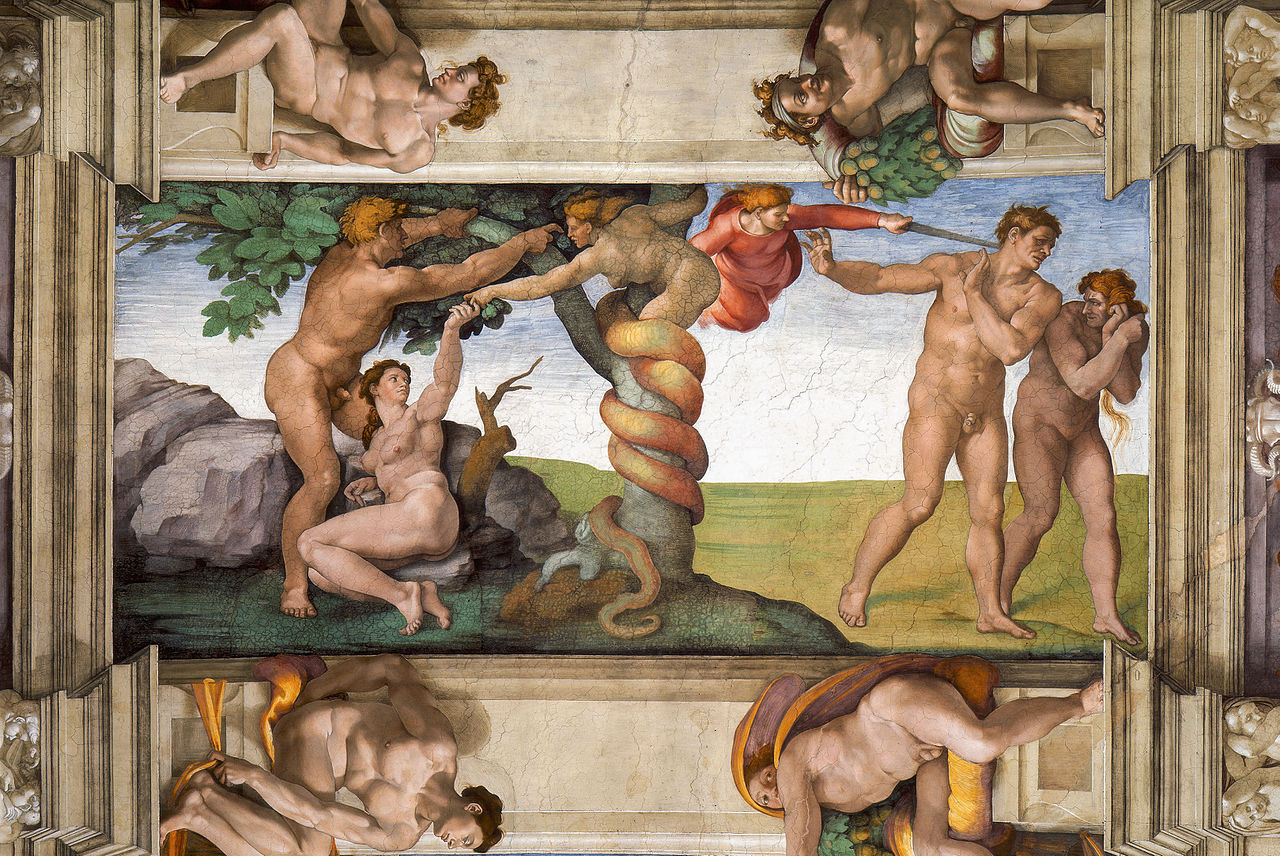
Despite the common interpretation that the serpent represents Satan in this myth, there is no indication that the serpent is anything other than a serpent. Some make the case that the serpent represents a female figure (Satan is traditionally male). For example, many early artist renditions of the garden scene show a snake with a female head. These artists’s weren’t small, unknown artists either. Michelangelo’s paintings on the Sistine chapel, the relevant part which is shown below, shows a female serpent lady (also known as a Naga) handing the fruit to Eve.

Given that Satan is male throughout the bible, the presence of female serpent figures is curious and raises some questions to today’s audience. If the serpent doesn’t represent Satan, then who does it represent?

If it’s the case that the the serpent DOES represent Satan, God’s punishment of the snake is overblown and completely misses the actual perpetrator. This is like having someone hand you a bag of money and having the police tackle and beat you a few moments later for robbing a bank while you watch the criminal walk down the street away from you.

Also, if the serpent represents Satan, then why, in all places of the bible, is he not moving around on his belly and eating dirt? God was very explicit in how long the curse would last: all the days of it’s life. Clearly all the days of Satan’s life haven’t happened yet (if Christians are to be believed), so why, in the book of Job, is Satan not on his belly? Why is there no instance of Satan eating dirt?

Finally, if the serpent here IS Satan, and Satan can’t tempt someone without god’s consent (see the book of Job), this was a huge setup for our first man and woman. What was the thought process? As the literal creator of humanity, does God not understand human nature and curiosity? Did God not realize that setting 2 humans loose in his garden who have the critical thinking skills of a toddler would end any differently?

The Scientific/logic/sequence mistakes in this chapter

  1. Serpents don’t talk[citation NOT needed] (Genesis 3:1)
  2. Fruit does not confer knowledge (Genesis 3:7)
  3. Eating the fruit did not kill them like God said (Genesis 3:7)
  4. God, commonly held to be omniscient, isn’t (Genesis 3:8-9, 3:11)
  5. Cruel and unusual punishment (God’s favorite kind) (Genesis 3:14-24)
  6. Incorrect ideas about pregnancy (Genesis 3:15)
  7. Anachronism: Swords weren’t a thing yet (Genesis 3:24)
  8. Magic (Genesis 3:1-24)

Chapter 3: Biblical Justification for Sexism.
AKA: It’s All Woman’s Fault
AKA: Cruel and Unusual Punishments

  1. Now the serpent was more subtil than any beast of the field which the Lord God had made. And he said unto the woman, Yea, hath God said, Ye shall not eat of every tree of the garden?
  2. And the woman said unto the serpent, We may eat of the fruit of the trees of the garden:
  3. But of the fruit of the tree which is in the midst of the garden, God hath said, Ye shall not eat of it, neither shall ye touch it, lest ye die.
  4. And the serpent said unto the woman, Ye shall not surely die:
  5. For God doth know that in the day ye eat thereof, then your eyes shall be opened, and ye shall be as gods, knowing good and evil.
  6. And when the woman saw that the tree was good for food, and that it was pleasant to the eyes, and a tree to be desired to make one wise, she took of the fruit thereof, and did eat, and gave also unto her husband with her; and he did eat.
  7. And the eyes of them both were opened, and they knew that they were naked; and they sewed fig leaves together, and made themselves aprons.
  8. And they heard the voice of the Lord God walking in the garden in the cool of the day: and Adam and his wife hid themselves from the presence of the Lord God amongst the trees of the garden.
  9. And the Lord God called unto Adam, and said unto him, Where art thou?
  10. And he said, I heard thy voice in the garden, and I was afraid, because I was naked; and I hid myself.
  11. And he said, Who told thee that thou wast naked? Hast thou eaten of the tree, whereof I commanded thee that thou shouldest not eat?
  12. And the man said, The woman whom thou gavest to be with me, she gave me of the tree, and I did eat.
  13. And the Lord God said unto the woman, What is this that thou hast done? And the woman said, The serpent beguiled me, and I did eat.
  14. And the Lord God said unto the serpent, Because thou hast done this, thou art cursed above all cattle, and above every beast of the field; upon thy belly shalt thou go, and dust shalt thou eat all the days of thy life:
  15. And I will put enmity between thee and the woman, and between thy seed and her seed; it shall bruise thy head, and thou shalt bruise his heel.
  16. Unto the woman he said, I will greatly multiply thy sorrow and thy conception; in sorrow thou shalt bring forth children; and thy desire shall be to thy husband, and he shall rule over thee.
  17. And unto Adam he said, Because thou hast hearkened unto the voice of thy wife, and hast eaten of the tree, of which I commanded thee, saying, Thou shalt not eat of it: cursed is the ground for thy sake; in sorrow shalt thou eat of it all the days of thy life;
  18. Thorns also and thistles shall it bring forth to thee; and thou shalt eat the herb of the field;
  19. In the sweat of thy face shalt thou eat bread, till thou return unto the ground; for out of it wast thou taken: for dust thou art, and unto dust shalt thou return.


  20. And Adam called his wife’s name Eve; because she was the mother of all living.
  21. Unto Adam also and to his wife did the Lord God make coats of skins, and clothed them.
  22. And the Lord God said, Behold, the man is become as one of us, to know good and evil: and now, lest he put forth his hand, and take also of the tree of life, and eat, and live for ever:
  23. Therefore the Lord God sent him forth from the garden of Eden, to till the ground from whence he was taken.
  24. So he drove out the man; and he placed at the east of the garden of Eden Cherubims, and a flaming sword which turned every way, to keep the way of the tree of life.
  1. Weren’t all animals created equally and perfect by god? Why would a serpent by more anything? I suspect the original author just hated snakes for some reason. This is speciests!
  2. aka: Yes….
    I like how she doesn’t care that a snake is talking. #DisneyPrincessConfirmed.
  3. But actually no. Also, she has literally no concept of what death is. She can’t make an informed choice here! She has no knowledge to draw on.
  4. How is this considered tempting? Eve has no critical thinking skills.
  5. Sounds like this would be a good thing in the end. Teach some critical thinking and reasoning skills to Eve so she can make informed choices.
  6. And this starts the moment of “It’s all woman’s fault”. You’d think an omniscient god would have known all this would happen and thus not made the woman or the serpent. Or put the tree or serpent in the garden.
  7. Because nudity is bad? Seriously… why is this writer so ashamed of nudity? This sounds like someone projection: “I’m not ashamed, you’re ashamed!”
  8. Mr. Omniscient should know where they are anyways, right?


  9. Apparently not. Maybe he didn’t want to give away the fact that he’s omniscient?
  10. Afraid, sure, but why because of nudity specifically? Nudity is no big deal NOR anything to be ashamed of.
  11. Not acting very omniscient if you ask me.


  12. AKA: “It’s not me, it’s your fault for giving me someone so wonderful that she wanted to feed me.”
  13. AKA: “It’s not my fault either! It’s really the serpent that you created! It’s smarter than I am because you didn’t give us any critical thinking skills!”
  14. Yeah… this author really doesn’t like snakes. They are well adapted to their lifestyle. Their ancestors had legs as evidenced by fossil records. Their lack of legs makes them a more effective predator in undergrowth. Also: They don’t eat dust.
  15. Everyone is supposed to hate snakes. This seed concept references an outdated idea of how impregnation works. See the notes below.
  16. This god fellow really isn’t very nice. He already “punished” the snake, now he’s causing untold pain and suffering unto billions of women. Probably accounts for deaths during childbirth too.
  17. It really doesn’t seem like the punishments are fitting the crime here. An omniscient and omnipotent god should be able to find a better way to punish everything here without causing suffering to untold billions of creatures.

  18. Cruel and Unusual Punishments, part 5. If you believe this verse, it appears that humans are supposed to be vegan.
  19. References the second creation story in the bible… does this mean the first is inconsequential or wrong? Also… did god create human death as a punishment here? Why do other animals still die if they never sinned?
  20. Weird name, but sure. Might make sense in the original language.
  21. AKA: God kills animals to make clothes


  22. Again, see rationalwiki for an explanation on the “us” mentioned here. God apparently doesn’t want people living forever and thinks death is the way to go. Good job causing even more suffering.
  23. So we are all supposed to be farmers now? Also note: No mentions of afterlife or punishments/rewards after death
  24. Is this “flaming sword” somehow sentient? Also, man and woman would have no idea what a sword is. Further reinforcing the idea that this is a myth intended for people of the time, not an actual account of what happened.

Additional Notes on Chapter 3

The “seed” referenced in verse 15 references an outdated concept of how women become pregnant. The idea is more akin to how plants are grown than humans. Men have seed that they carry around, and they drop that seed into a woman. The woman is viewed as having a field in which the seeds are planted and children begin growing.

For information on fossils showing shakes with legs: https://web.archive.org/web/20200618154613/http://www.reptilesmagazine.com/Snakes/Wild-Snakes/Snake-Leg-Origins-Legless/

It seems weird that god would also put a tree of life in the garden. Why was it there if everything was immortal already? Was he just looking for an excuse to toss them out of the garden?

As always, check out the rationalwiki’s annotated version of Genesis for more points. These are just the points I feel are important to point out when I read through this.

Genesis Annotated: Chapter 2

Overview of Chapter

This starts by closing off the first creation myth and immediately starts another one. For some reason, every Christian I have talked to doesn’t realize this. The second creation myth involves a far more convoluted idea on how women came to be. Why didn’t god just create both male and female like in chapter 1? Why was this chapter even included in genesis when it’s directly contradictory to chapter 1?

Additional Thoughts

Why there is a second creation mythos immediately after the first finishes is unclear to me. While the first account has man created pretty much like anything else, this one goes out of it’s way to ensure that special treatment is given. Why? I assume because the author viewed humans as inherently special and different from other animals. This is reinforced by the author having man created before “Every beast of the field” and being told by god to name everything.

Additionally, if we’re to ascribe omnipotence and omniscience to god here, then why has god created man alone only to realize after the fact that he should have created a female counterpart for man as well? Shouldn’t a god that is omniscient know the outcome of everything that is going to happen before the action is taken? Shouldn’t a god that is omniscient know immediately what kind of “helper” man needs rather than faffing about and creating every other animal on the planet for man to have a trial run with? While many other questions could be raised, this is another indication that shows how god was not always ascribed the omni- traits that Christians assign to god today.

Due to rule number 3 that I’m holding the bible to (that the bible is wonderfully consistent throughout), I must point out that we’re only 2 chapters in on the first book and already have a bunch of inconsistencies. To name two, we have Light/dark being separated twice in chapter 1 and two creation stories with conflicting series of events. Was man made and then the beasts of the earth, or the beasts first and man second?

The Scientific/logic/sequence mistakes in this chapter

  1. Closes the first creation myth and starts a second (Genesis 2:3-4)
  2. Order of creation for second myth contradicts the first
  3. Some plants can use mist for water, most cannot. (Genesis 2:5-6)
  4. Only 2 humans created, not many like in chapter 1 (Genesis 2:7)
  5. Trees aren’t considered plants in this account (Genesis 2:9)
  6. Trees don’t confer knowledge[Citation NOT needed] (Genesis 2:9)
  7. An omnipotent god should know placing the tree here and saying “don’t eat it” isn’t going to work (Genesis 2:16-17)
  8. Why would Adam or Eve have a concept of mother, father, husband, or wife? (Genesis 2:24)
  9. There is nothing wrong with nudity no matter what this (and later chapters) claim (Genesis 2:25)

Chapter 2: A second account of creation
AKA: God Does Stuff Again

  1. Thus the heavens and the earth were finished, and all the host of them.
  2. And on the seventh day God ended his work which he had made; and he rested on the seventh day from all his work which he had made.
  3. And God blessed the seventh day, and sanctified it: because that in it he had rested from all his work which God created and made.
  4. These are the generations of the heavens and of the earth when they were created, in the day that the Lord God made the earth and the heavens,


  5. And every plant of the field before it was in the earth, and every herb of the field before it grew: for the Lord God had not caused it to rain upon the earth, and there was not a man to till the ground.
  6. But there went up a mist from the earth, and watered the whole face of the ground.


  7. And the Lord God formed man of the dust of the ground, and breathed into his nostrils the breath of life; and man became a living soul.
  8. And the Lord God planted a garden eastward in Eden; and there he put the man whom he had formed.
  9. And out of the ground made the Lord God to grow every tree that is pleasant to the sight, and good for food; the tree of life also in the midst of the garden, and the tree of knowledge of good and evil.
  10. And a river went out of Eden to water the garden; and from thence it was parted, and became into four heads.
  11. The name of the first is Pison: that is it which compasseth the whole land of Havilah, where there is gold;
  12. And the gold of that land is good: there is bdellium and the onyx stone.
  13. And the name of the second river is Gihon: the same is it that compasseth the whole land of Ethiopia.
  14. And the name of the third river is Hiddekel: that is it which goeth toward the east of Assyria. And the fourth river is Euphrates.
  15. And the Lord God took the man, and put him into the garden of Eden to dress it and to keep it.
  16. And the Lord God commanded the man, saying, Of every tree of the garden thou mayest freely eat:
  17. But of the tree of the knowledge of good and evil, thou shalt not eat of it: for in the day that thou eatest thereof thou shalt surely die.
  18. And the Lord God said, It is not good that the man should be alone; I will make him an help meet for him.
  19. And out of the ground the Lord God formed every beast of the field, and every fowl of the air; and brought them unto Adam to see what he would call them: and whatsoever Adam called every living creature, that was the name thereof.
  20. And Adam gave names to all cattle, and to the fowl of the air, and to every beast of the field; but for Adam there was not found an help meet for him.
  21. And the Lord God caused a deep sleep to fall upon Adam, and he slept: and he took one of his ribs, and closed up the flesh instead thereof;
  22. And the rib, which the Lord God had taken from man, made he a woman, and brought her unto the man.
  23. And Adam said, This is now bone of my bones, and flesh of my flesh: she shall be called Woman, because she was taken out of Man.
  24. Therefore shall a man leave his father and his mother, and shall cleave unto his wife: and they shall be one flesh.
  25. And they were both naked, the man and his wife, and were not ashamed.

  1. Everything is completed? This chapter soon contradicts itself by redoing it.
  2. Alternative text for the verse: God ran out of steam after a week of work and decided it was time for a nap.

  3. Nap day is special. This account is similar to the Sumerian Enuma Elish, the oldest known creation myth and reworked to emphasize one powerful being.
  4. This starts a recap of the creation tale. Remember, chapter 1 said heaven/earth -> light -> darkness -> day/night -> firmament -> dry land -> plants -> “lights in the firmament” -> sea/air creatures -> land creatures -> man
  5. Plants are made, herbs specifically called out. Without rain, how would these survive? Were these ALL plants that live near a large body of water? Was the ocean not salty at this point?
  6. Some plants can use fog/mist as a water source, but others can’t. Where did any that can’t come from if everything was misty for a long time? Plants that use fog as a water source usually have specialized method to collect it and drop it to the ground. Why don’t we see more of these today?
  7. Man created from dust. Humans are a wizard’s clay golem in this account. I fail to see how that makes humanity special in any way.
  8. So now a special garden is made. When was this made exactly? Day 3? 4? 5? 6? Do days even matter now?
  9. So… Trees aren’t plants now? I thought all plants were already made? Also… what exactly is this tree of good or evil? Can I have one? I’d like to grow know-fruit and sell it to some idiots I know.
  10. 1 river splits off into 4. Why is this even here? It’s not important.

  11. 1 river called Pison. Why is this even here? It’s not important

  12. Why is this verse even in here? Wasn’t this a tale of creation?
  13. 1 river called Gihon. There is a LOT of debate as to where this river is/was

  14. 1 river called Hiddekel, one called Euphrates. Why are these even mentioned?
  15. Man is in the garden. BTW: Adam literally means Man. So any references to Adam are actually “man” or “the man”.
  16. Eat anything in the garden!


  17. Oh wait, don’t touch that super special knowledge tree. It has murder fruit growing on it.

  18. God decides that man shouldn’t be alone. Is this admission that he’s already made a mistake?
  19. So he promptly makes “every beast of the field”. Bestiality much? Apparently this Adam guy was quite the categorizer, because he names everything. Not sure what else he might have done with the animals too since they were made for him.
  20. Names names names, but Adam doesn’t like any of these beasts. Guess god didn’t know what he wanted off the bat? What happened to “all knowing”?
  21. He rufies Adam, grabs a bone from his body, and sealed the flesh up. Nothing about fixing the bone? How is Adam not in pain after this?
  22. Men are clay golems while women are flesh golems. It’s in the bible kids, the wizard is real!
  23. I assume that the original language has a word for “from man”. English does not


  24. Men and woman are meant for each other! Also, why would these 2 have any concept of father/mother?
  25. Why does this matter? There are literally places for people to go to in order to get naked nowadays, and the only reason they’re forced to go there is because society, not the people themselves, are ashamed.

Additional notes on chapter 2

This chapter implies that humans have always practiced agriculture. This is false. Humans started as hunter-gatherers and moved to agriculture around 9500BCE

For information on the Enuma Elish, check out the following links
https://www.ancient.eu/article/225/enuma-elish—the-babylonian-epic-of-creation—fu/